
Radioactive Resin Waste Treatment (SCEPTER®)
An advanced radioactive resin waste treatment process for selective C‑14 removal that cuts disposal costs, eliminates airborne emissions, and recovers a valuable isotope.
Get in Touch
Our Global Team
Canada

Mina Shinouda
Senior Director, Tech. & Strategic Ventures, CanadaOur Global Team
United States

Jenna Gatto
VP, Operations, United StatesOur Global Team
International

Shahrokh Zangeneh
Chief Commercial Officer, International
Radioactive resin waste treatment manages ion exchange (IX) resins that become radioactive during nuclear plant operation. In CANDU reactors, IX resins used for water purification accumulate carbon‑14 (C‑14). Due to its 5,730‑year half‑life, resins from the moderator purification circuit are classified as intermediate level waste (ILW), which is significantly more expensive to dispose of than low level waste (LLW).
Kinectrics’ SCEPTER® (Selective Carbon Extraction Process Through Exchange Reaction) selectively removes carbon‑14 from waste IX resins, reducing disposal costs by concentrating the C‑14 into a small volume and reclassifying the remaining material as LLW. Unlike conventional treatments such as thermal processing, acid stripping, supercritical fluid extraction, and non‑selective ion exchange, SCEPTER® operates at ambient temperature and pressure, uses no highly hazardous chemicals, and produces no harmful environmental emissions, while recovering C‑14 for medical, industrial, and emerging betavoltaic (nuclear battery) applications.
Our Advantages in Radioactive Resin Waste Treatment
-
Produces an In-Demand Radioisotope
Carbon-14 is used in radiochemical R&D and as a radiotracer for medical, agricultural, and ecological research. It may also be used in Carbon-14 based betavoltaic devices (nuclear batteries) that if successful would greatly increase the demand for this useful radioisotope.
-
Green Technology
This unique, patented process reduces the environmental impact of radwaste management. It does not use any hazardous chemicals, operates at ambient temperature and pressure, and produces no airborne emissions. The proprietary carbon-14 extraction reagent can be recycled and reused.
-
Flexible, Scalable and Easy to Install
The SCEPTER® technology is an expandable modular design, which is scalable to meet any of your needs. It is portable and easy to install and access.
-
Dramatically Reduces Waste Disposal Costs
SCEPTER® enables the reclassification of resin waste from intermediate to low level resulting in savings of hundreds of thousands of dollars in disposal costs for each cubic meter of waste.
Radioactive Resin Waste Treatment Technical Abilities
The SCEPTER® Technology
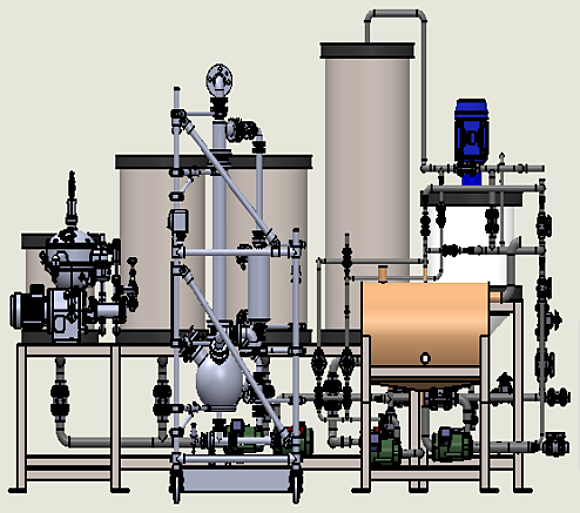
The treatment process contains two main chemical steps starting with a proprietary carbon extraction reagent that removes the carbon-14 from the resin followed by a precipitation reagent that converts the extracted carbon to an insoluble low volume material.
The resin, without the carbon-14, is dried under gentle conditions using minimal energy and reduced in volume. The precipitation chemistry has been selected in a way that the second step regenerates the original extraction reagent. This provides both cost-saving and environmental benefits.
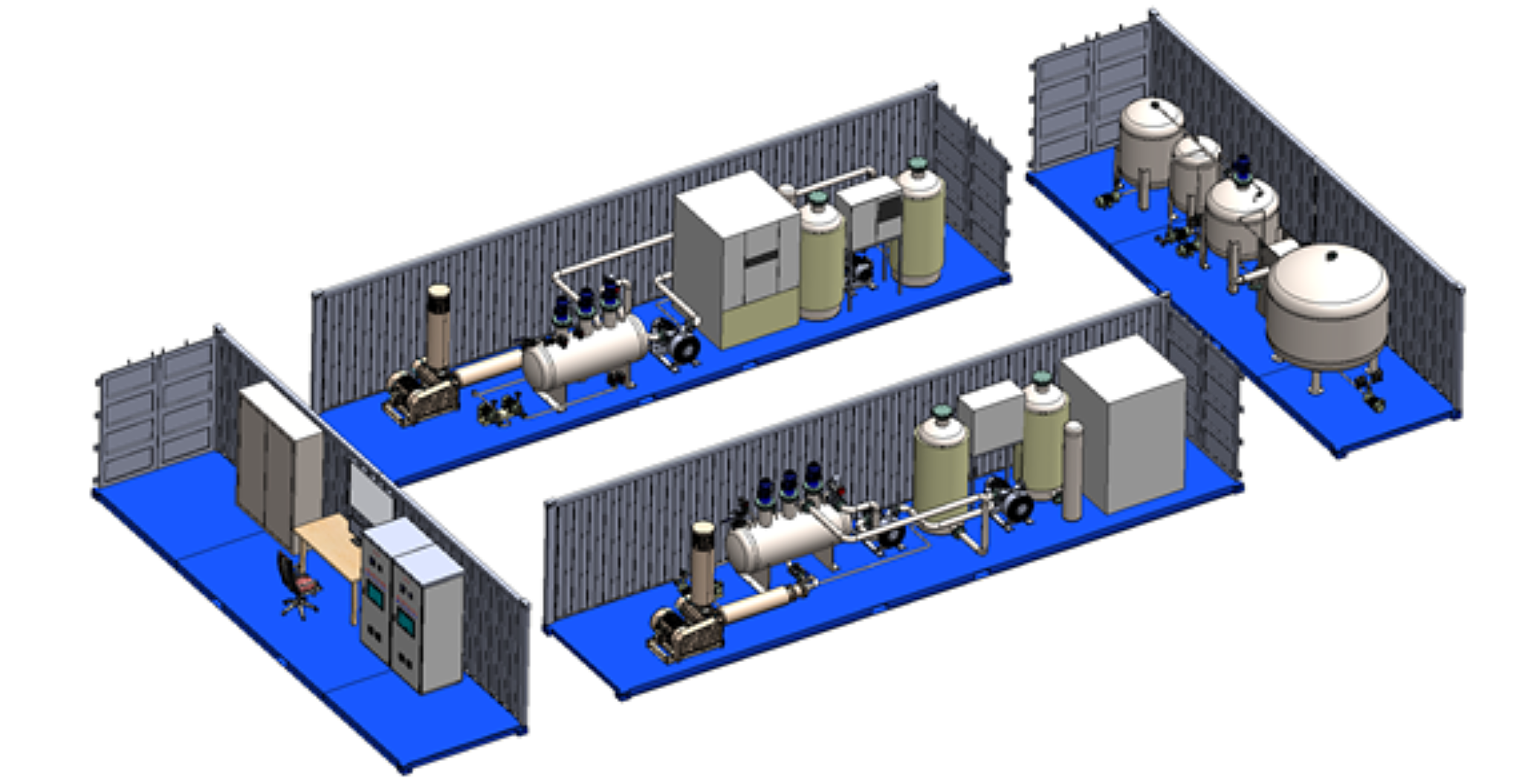
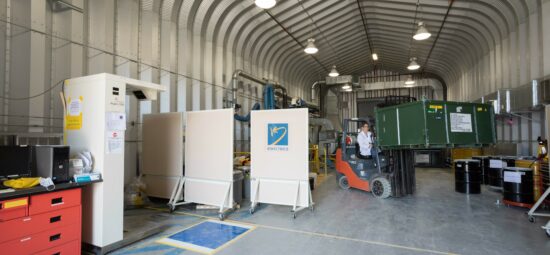
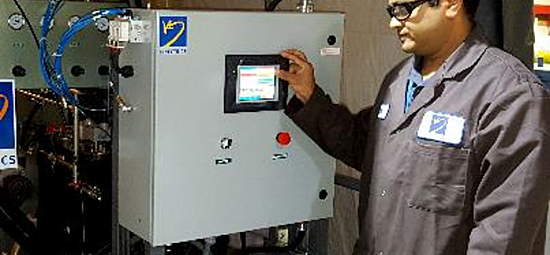
The system is installed in transportable modules.
Waste Volume Reduction
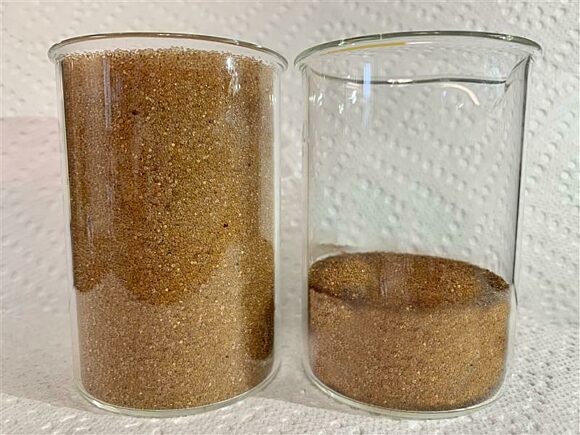
The treated resin waste is volume-reduced to as little as 30% of its original volume. The carbon-14 byproduct occupies only 3% of the original resin waste volume, with storage in a stable, water-insoluble form. The SCEPTER® process has been demonstrated to achieve a 90% or better extraction of carbon-14 with minimal extraction of other radionuclides.
The carbon‑14 that is extracted from the waste resin is exclusively contained in the ILW secondary waste, comprising 3% of the original waste volume. This material is recovered in a stable, solid, water‑insoluble form that can be safely stored. If needed, carbon‑14 can easily be extracted from this material, isotopically enriched, and made available for research and medical use.
Carbon-14 Production
The SCEPTER® technology selectively extracts Carbon-14 from the ion exchange resins and concentrates it into a solid, insoluble, low-volume, material. Carbon-14 can be easily extracted from this material, purified, and made available for sale.
Carbon-14 is a very useful tracer as it can be labeled onto any organic molecule to allow it to be easily traced. This enables the investigation of such things as how drugs distribute themselves in our bodies, how plants take up nutrients, and how flora and fauna distribute themselves in our environment.
Related Capabilities
Downloads
-

SCEPTER™ Process - Brochure
Download Opens in new tab
Our Proven Experience
Quality Assurance & Technical Standards
- ISO 9001
- Quality Management System
- ISO 17025
- Testing & Calibration Laboratories
Related Media & News

Keep Exploring
Visit our media center to find news and helpful resources from Kinectrics.
Visit the Media CenterKinectrics Training
To get yourself or your staff up to speed on the latest electricity generation standards, sign up for one of Kinectrics’ training courses.
Train with us
Let's Work Together
Whether it’s about our world-renowned team, our laboratories, or our lifecycle management solutions, we’re happy to answer any questions you might have.
Get in Touch