


Radiological Safety Analysis Software
This state-of-the-art software suite is designed to meet the current nuclear industry standards, delivering solutions to simplify the licensing process and meet the evolving demands of the nuclear industry.
Get in Touch
Our Global Team
International

Peter Maka
Technical Expert, Nuclear Safety & Licensing, International
Radiological safety analysis software is used to support licensing of nuclear facilities by modeling and assessing radiological consequences to workers and the public due to release of radioactivity to the environment. The software considers all aspects of radiological consequence assessments while adhering to nuclear standards such as the CSA N288 series of standards. The nuclear industry uses software like this to demonstrate compliance with radiological dose limits for human and non-human receptors set by regulatory bodies. Using such tools is essential for protecting workers, the public, and the environment while supporting nuclear facilities' safe and efficient operation.
Kinectrics developed this software suite to facilitate licensing of nuclear facilities. Leveraging decades of expertise in software development, maintenance, qualification, and analysis for nuclear applications, our tools are tailored to support a wide range of applications. ORCA (On/Off-site Radiological Consequences of Accidents) and RINO (Radiological Impacts of Normal Operations) are built to comply with stringent nuclear standards, including CSA N288, CSA N286.7 and NQA-1 (for ORCA). These analyses are vital for ensuring nuclear facilities' safety, compliance, and efficiency, providing insights to protect people and the environment while supporting seamless operations. By developing robust, user-friendly tools, Kinectrics is one of the leaders in radiological analysis solutions.
Our Advantages in Radiological Safety Analysis Software
-
Easy to Use
Leveraging decades of experience in safety analysis, our software is specifically designed to be user-friendly. It offers intuitive navigation and a straightforward graphical interface, ensuring a hassle-free experience while maintaining robust performance.
-
Wide Range of Applications
Our software is versatile, supporting various applications such as site evaluation studies, deterministic and probabilistic safety assessments, emergency planning, plant habitability assessment, design assist analysis, normal operations, and decommissioning.
-
CSA N288, CSA 286.7 and NQA-1 Compliance
Our software is built to meet current nuclear standards, including CSA N288, CSA 286.7, and NQA-1 (for ORCA), ensuring usability across a broad range of jurisdictions.
-
Proven Track Record
Our tools have been successfully used to license nuclear facilities in a broad range of jurisdictions (see our list of clients below).
Radiological Safety Analysis Software Technical Abilities
Radiological Safety Analysis Explained
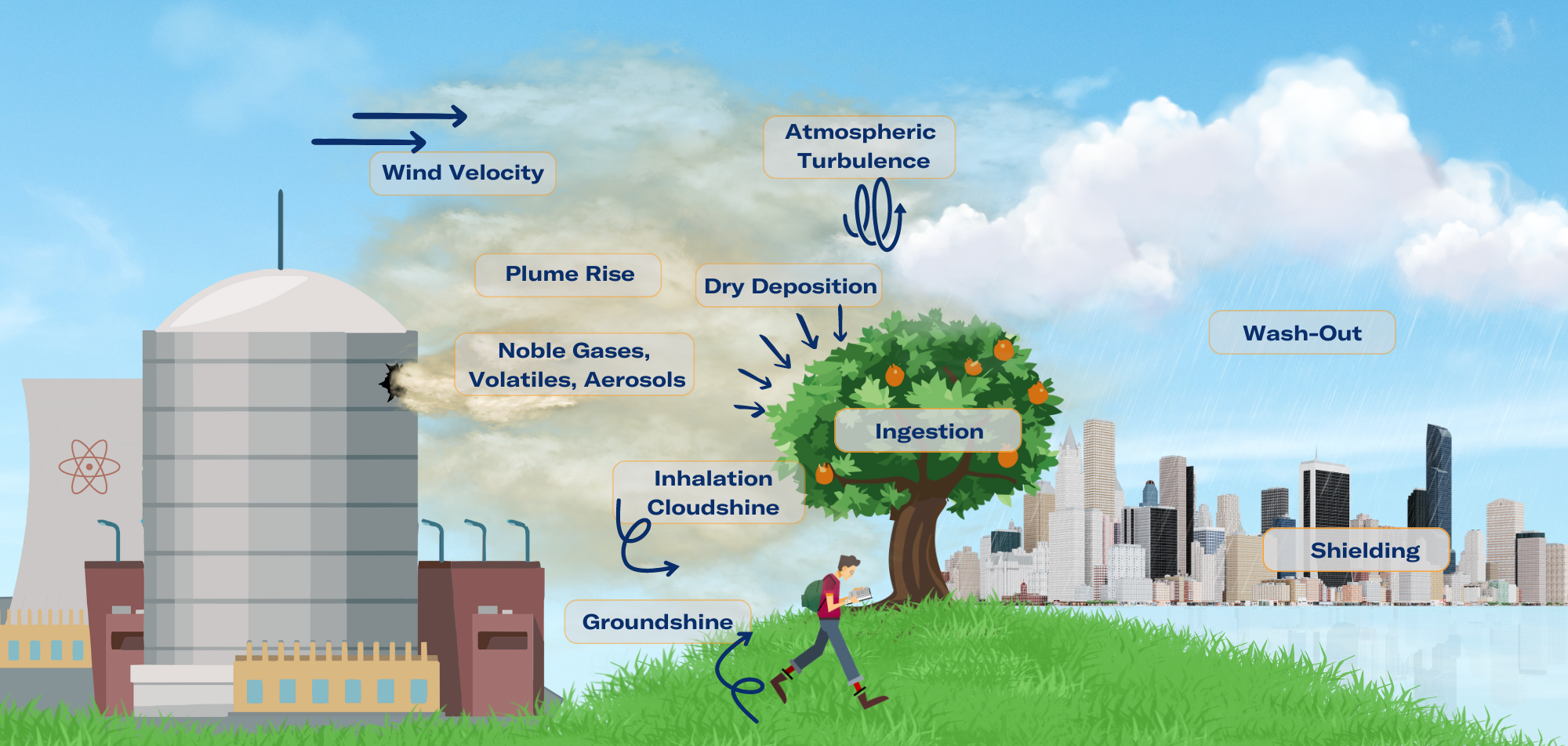
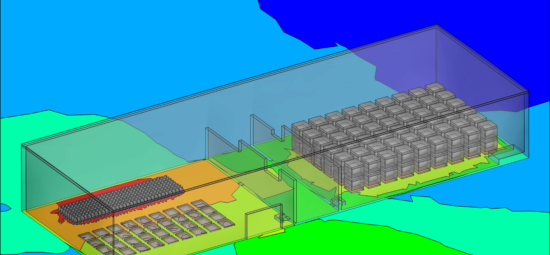
Radiological safety analysis evaluates the radiological consequences to workers or members of the public from routine or accidental releases of radioactivity to the environment. Phenomena such as atmospheric turbulence, plume rise, stack and building downwash, radionuclide decay, dry deposition and washout are modeled to accurately predict the concentration of these materials in the environmental media (e.g., air, surface water, soil, plant and animal life) surrounding the nuclear facility. The dose consequences to an individual are then calculated by accounting for a variety of exposure pathways including inhalation, cloudshine, groundshine and ingestion, as appropriate. The results of the analysis are used to demonstrate compliance with dose limits set by the regulator.
Software Capabilities - ORCA
ORCA (On/Off-site Radiological Consequences of Accidents) calculates atmospheric dispersion and radiological doses following accidental airborne releases from nuclear facilities, following CSA Standard N288.2. The code supports calculations for facilities close to site boundaries (known as the near field) with the implementation of the dispersion parametrizations in NUREG/CR-6331, which is consistent with software accepted by the U.S. NRC.
Software Capabilities - RINO
RINO (Radiological Impacts of Normal Operations) models the public’s radiation exposure from radionuclides released by nuclear facilities during normal operation, following CSA N288.1. The software also evaluates the impact of conventional and radiological contaminants on non-human biota for nuclear facilities, following the CSA Standard N288.6. RINO can also compute the Derived Release Limits (DRLs) or Derived Emission Limits (DELs) for nuclear facilities, which need regulatory approval and are part of the operating license.
Publications
- ORCA: A Tool for Radiological Consequences for Accidental Releases, Nuclear Science and Engineering, March 2024.
- XDOSE*: A Tool for Radiological Consequences for Accidental Releases from the Xe-100, M&C 2023 - The International Conference on Mathematics and Computational Methods Applied to Nuclear Science and Engineering, August 2023.
- XDOSE*: A Tool for Radiological Consequences for Accidental Releases from the Xe-100, Fourth International Conference on Generation IV & Small Reactors (G4SR-4), October 2022.
- RINO: A New Tool for Assessing Radiological Impacts of Normal Operation, CNS/CNA Annual Conference, June 2023.
- Ecological Risk Assessment Software for Radioactive Waste Management Facilities. Presented at WM2015 - Annual Waste Management Symposium, Phoenix, Arizona, USA, March 2015.
*ORCA was formerly known as XDOSE
Related Capabilities


Downloads
-

Radiological Safety Analysis - Brochure
Download Opens in new tab
Our Proven Experience
Key Clients

Projects
Nuclear Reactor Licensing Support
Related Media & News


Keep Exploring
Visit our media center to find news and helpful resources from Kinectrics.
Visit the Media CenterKinectrics Training
To get yourself or your staff up to speed on the latest electricity generation standards, sign up for one of Kinectrics’ training courses.
Train with us
Let's Work Together
Whether it’s about our world-renowned team, our laboratories, or our lifecycle management solutions, we’re happy to answer any questions you might have.
Get in Touch